
RaymanTech is your specialized technology partner for high-precision x-ray food inspection.
In modern food production, conventional controls are often no longer enough. Products and packaging have grown dramatically more complex, and consumers and retail chains tolerate zero foreign bodies. A single recall can permanently damage trust in a brand and generate enormous costs.
Many manufacturers still rely on metal detectors, which do an excellent job detecting iron and stainless steel. But in today's production reality, they run into physical limits. Stones in muesli, glass shards in jam, or bone fragments in chicken fillet remain invisible to magnetic coils. Add to this the trend toward aluminum-coated packaging and metallized films, which often makes conventional metal detectors unusable or forces a reduction in sensitivity.
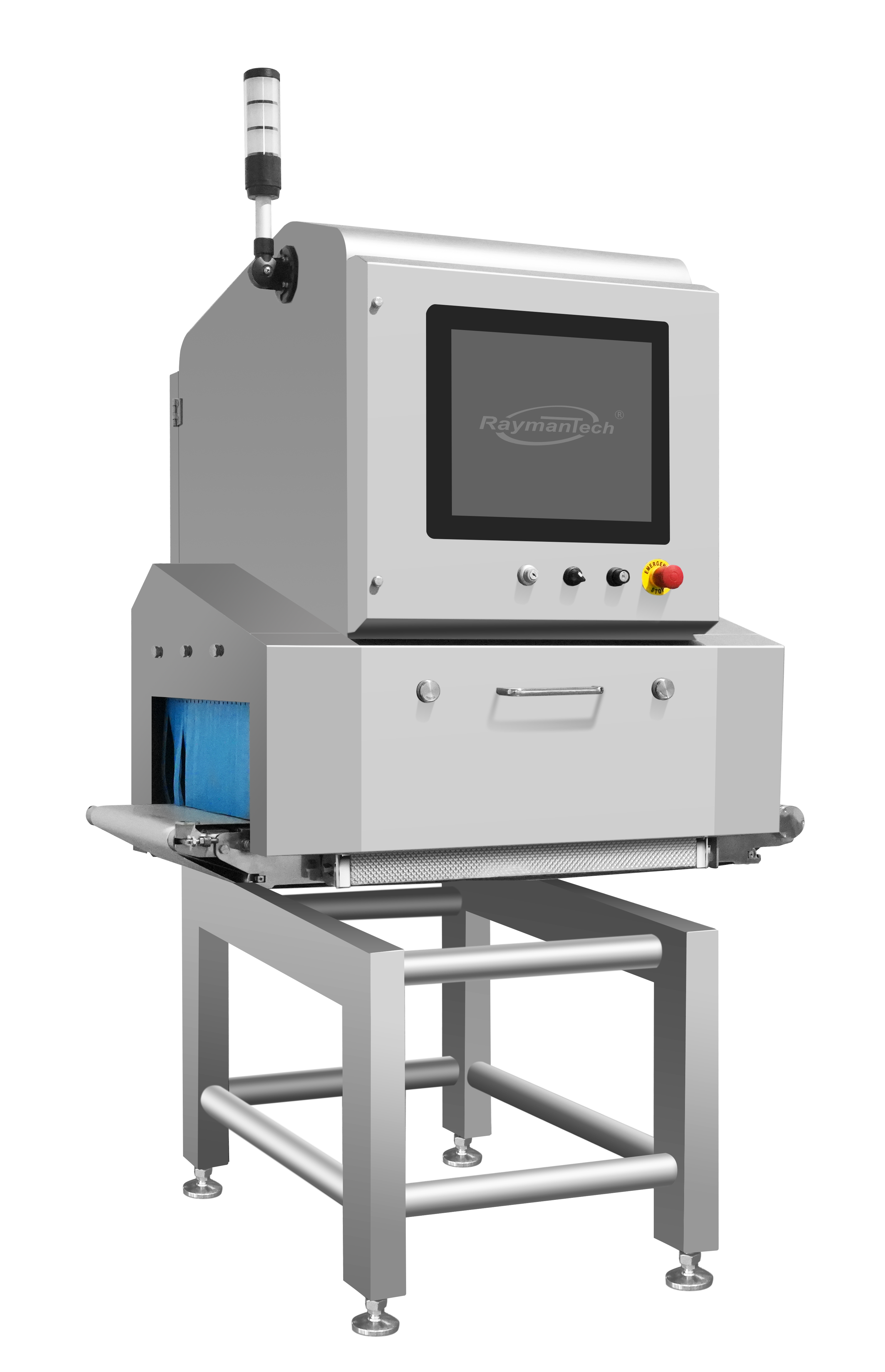
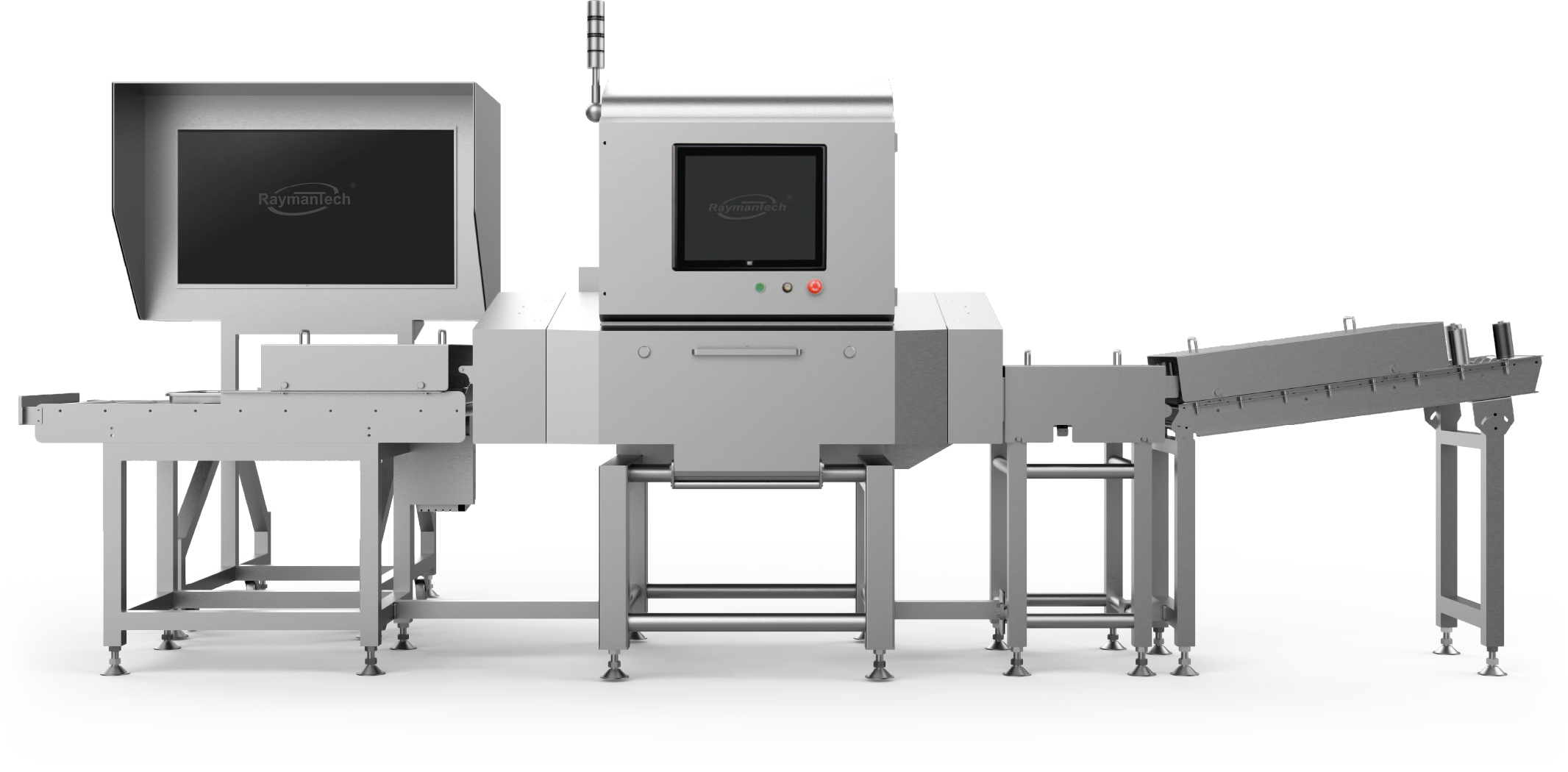
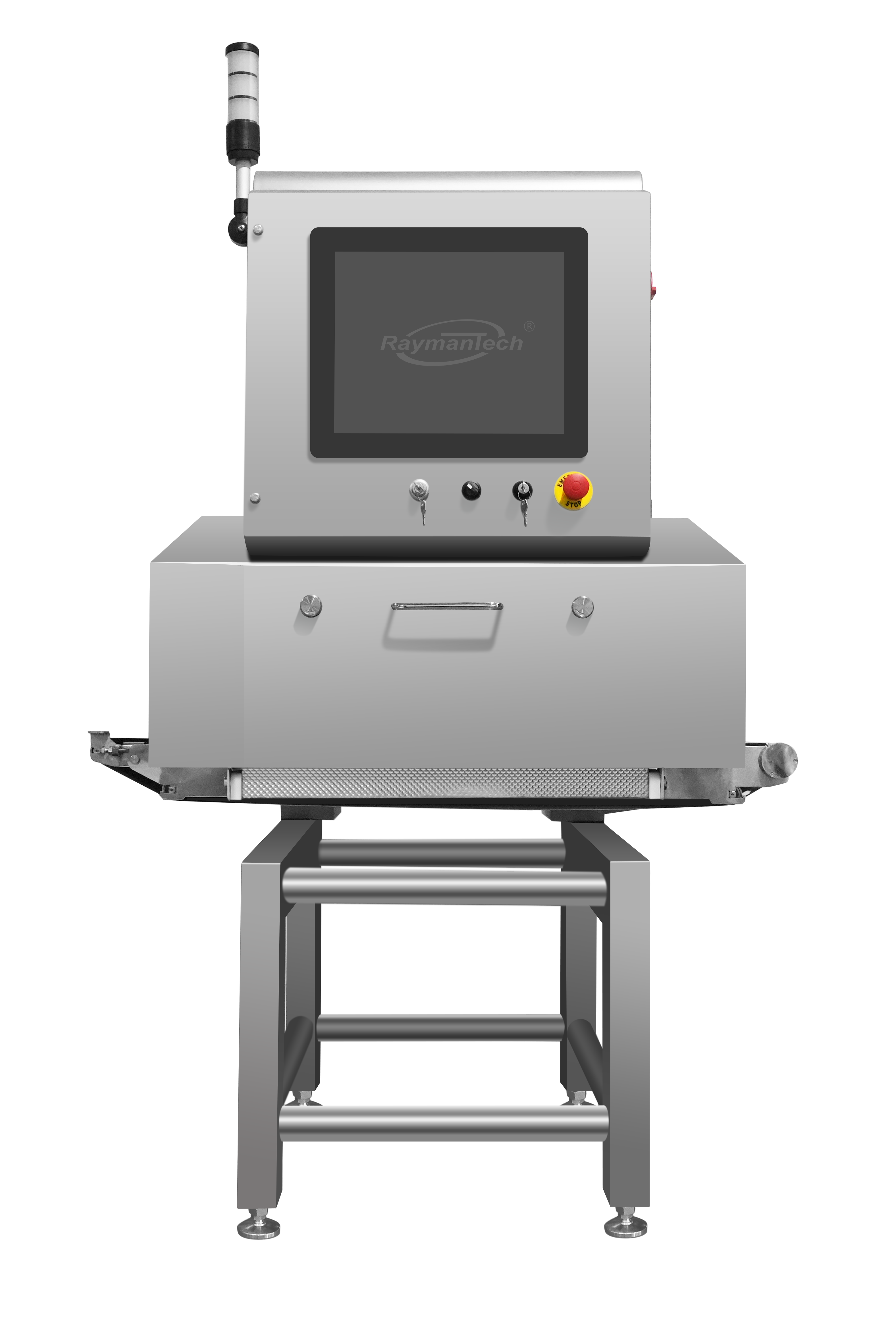
This is exactly where RaymanTech's x-ray food inspection comes in. It closes the safety gap that other technologies have to leave open, giving you certainty where inductive sensors are blind. Our x-ray inspection systems for food contamination reliably cover the critical control points and document every batch seamlessly for your auditors.
An x-ray scanner for food works fundamentally differently from a metal detector. While metal detectors rely on electrical conductivity, x-ray inspection of food analyzes product density.
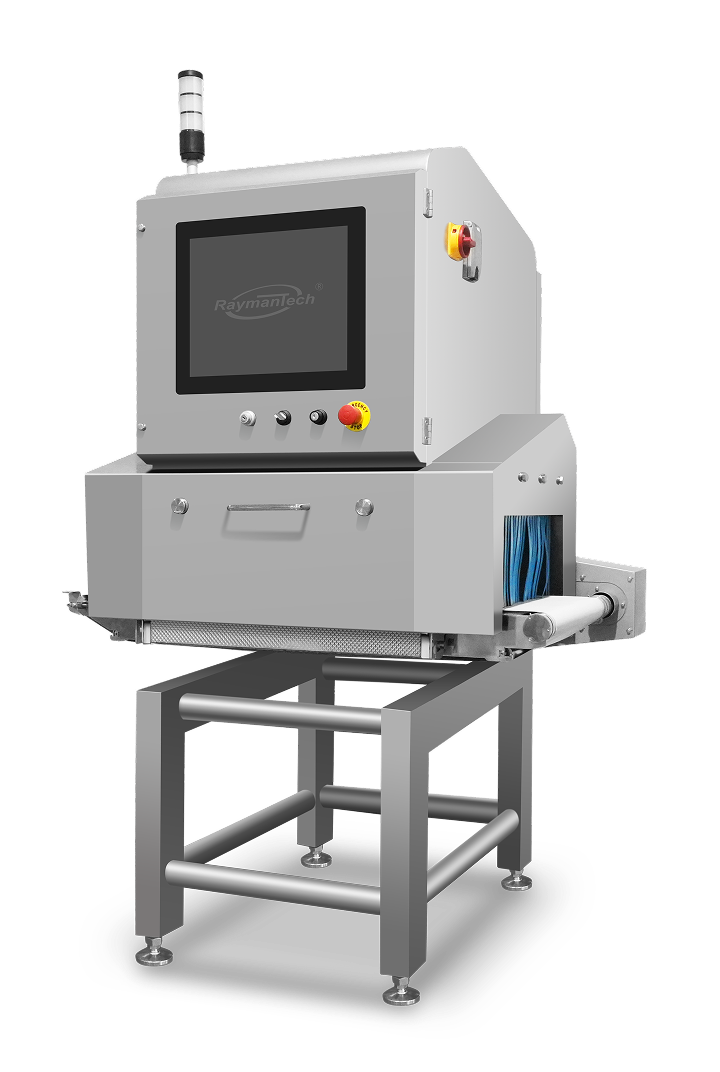
The physical principle is precise and safe. A generator produces an x-ray beam that passes through the product on the conveyor belt. A detector beneath the belt measures the remaining radiation intensity — the denser a material, the more radiation it absorbs.
On the resulting grayscale image, foreign bodies with higher density than the surrounding product appear as dark contrasts. Our advanced image-processing software analyzes these images in milliseconds and decides pass or fail.
X-ray inspection makes it possible to identify a wide range of foreign bodies, regardless of the product's temperature, moisture, or salt content. For applications focused exclusively on metallic contaminants, and where aluminum-containing packaging isn't used, it may also be worth taking a look at our metal detectors for the food industry.
01
This is one of the most demanding tasks in the food industry. Our systems reliably detect glass shards even inside glass jars or bottles. Special algorithms mask the curved glass base so even the smallest splinters are found there too.
02
In meat and poultry processing, this is a decisive competitive advantage. RaymanTech scanners find calcified bone from 2 millimeters upward, as well as cartilage residue — in fresh product and frozen blocks alike.
03
Mineral contaminants pose a major risk in produce, nuts, or bulk goods. Our technology reliably distinguishes between the product and stones of the same size based on density.
04
Abrasion from machine components, PVC or Teflon seals, and hard plastic parts can be detected, provided their density is significantly higher than that of the food — this should be verified case by case.
A modern food x-ray inspection system is far more than a foreign-body detector — it acts as a comprehensive quality assurance tool. RaymanTech uses the x-ray images it generates to check further important product parameters alongside the foreign-body search. This increases your overall equipment effectiveness (OEE) and prevents complaints that have nothing to do with contamination.
Is a chocolate missing from the box, or a bar from the multipack? Our software counts the components inside the sealed packaging. Incomplete units are automatically rejected before they reach retail.
Deformed burger patties or broken cookies in the pack don't meet your quality standards. RaymanTech's image processing reliably detects breakage and shape defects. It can also identify product caught in the seal seam, which could compromise shelf life and pack integrity.
Thanks to this multi-functionality, a single x-ray inspection system often replaces several separate inspection devices, such as checkweighers or optical sensors — saving valuable floor space on your production line.
Air pockets in cheese blocks or underfilled yogurt cups can be identified by analyzing the grayscale sums in the x-ray image. This helps you comply with fixed-quantity packaging regulations and also prevents "give-away" — unintentionally handing out extra product through systematic overfilling.
Every food product places its own demands on handling and food x-ray inspection technology. RaymanTech offers specialized solutions across a range of sectors.
Contact usHere the focus is clearly on bone detection and hygiene. Our systems are built in hygienic design: angled surfaces let water drain away, and belts can be removed tool-free for daily high-pressure cleaning (IP69K). We offer special software filters that boost the contrast of bone against soft tissue, substantially increasing detection reliability.


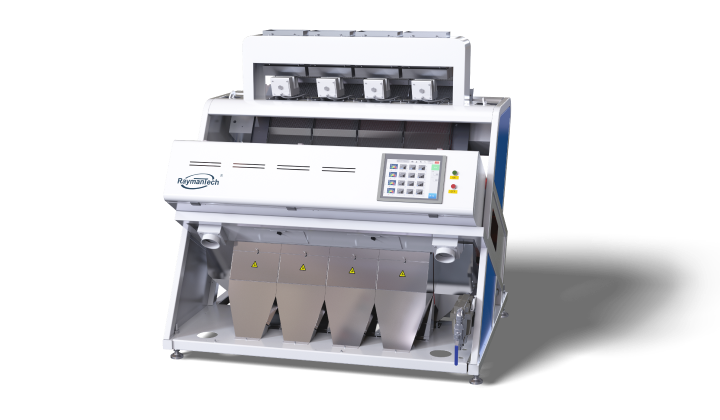
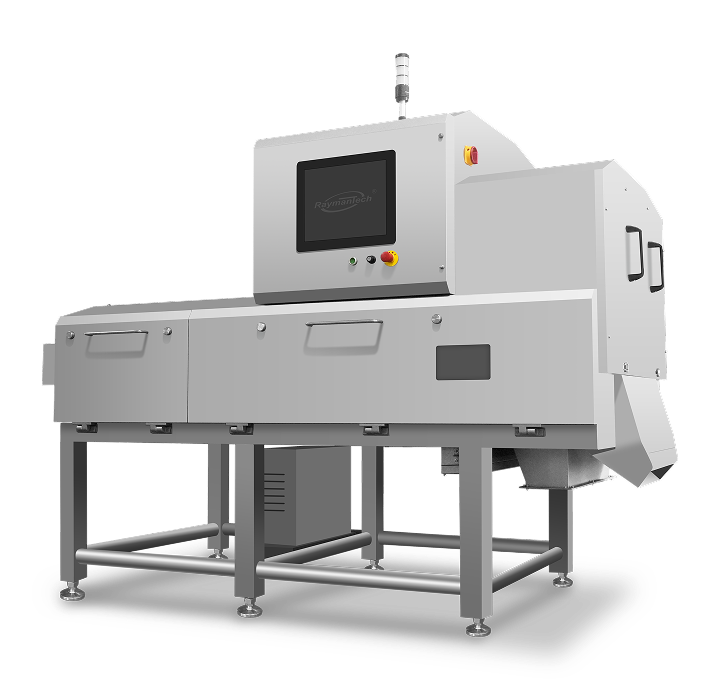
We cover the entire process chain, from raw material to finished product. For unpackaged bulk goods such as nuts, grain, or granulates, we integrate our RaymanTech Bulk-Flow systems, which sort out foreign bodies such as stones during free fall or on the infeed belt. For final inspection of packaged baked goods, our efficient RaymanTech Eco-Series is typically used instead. It runs low-attenuation belts that don't degrade the x-ray image and performs precisely even at the high belt speeds of modern packaging lines.
For yogurt, quark, or soups moving through pipework, we integrate pipeline x-ray systems that inspect the product before filling. For already-packaged products in cans, jars, or composite cartons, we offer side-view scanners, where the generator is mounted to the side to scan the entire container — including the base and fill level — horizontally.

The complexity of ready meals with multiple components (meat, vegetables, side dish) in a single tray calls for intelligent software. Our systems can define separate zones within a single pack and inspect each at a different sensitivity.
If you also need a purely visual inspection of the product surface, we recommend combining this with our optical sorting systems.
A common problem in quality control is false rejects. Many foods, such as cheese, meat, or warm baked goods, show high inherent conductivity or varying density. With conventional technology, this often causes perfectly good product to be wrongly flagged as contaminated and discarded.
RaymanTech uses advanced algorithms and AI support to filter out this "product effect." Our systems learn your product's natural variance and reliably distinguish between an actual bone fragment and a harmless density fluctuation in the meat structure.
Reducing the false-reject rate has a direct impact on your operating costs: less product wrongly discarded means lower material losses and less waste, and it also reduces the labor needed to manually recheck rejected product. An investment in high-quality x-ray food inspection equipment often pays for itself through these savings alone, faster than expected.
In the age of digitalization, data integrity is a key factor in food safety. RaymanTech systems are smart-factory ready and integrate seamlessly into your existing IT infrastructure and ERP systems.
For IFS or BRC audits, you need complete, gapless records. Our x-ray inspection systems for the food industry automatically log all relevant events, including system status, test results using test pieces, and images of every rejected product. This data is stored tamper-proof and can be retrieved at any time. A sophisticated user-management system with multiple access levels also prevents unauthorized staff from changing critical parameters.
Contact us
It's important to distinguish between "irradiation for preservation" and "x-ray inspection for foreign-body control." Irradiation for preservation uses extremely high energy doses and is subject to strict approval restrictions. X-ray inspection, as RaymanTech offers it, is purely an inspection method. It is fully permitted and standard practice in Germany and across the EU. The energy used is millions of times lower than in preservation irradiation — it does not fall under the irradiation ban, since it does not alter the food. Food that has passed through an inspection scanner is safe, fit for sale, and requires no special labeling.
The term "food scanner" is often used loosely for various analysis devices. In an industrial context, it usually refers to an x-ray inspection system that scans food to check its internal quality. Unlike optical scanners, which only see the surface, a food scanner (x-ray scanner) looks inside the product. It detects physical contaminants and structural defects non-destructively. The term is sometimes also used for handheld sensors that measure ingredients (such as sugar content), but in industrial manufacturing, the x-ray scanner remains the established system.
When it comes to conventional food irradiation for microbial reduction and preservation (not inspection), EU rules are strict. EU-wide, only dried aromatic herbs and spices are approved for irradiation. Some EU countries hold national exemptions for additional products, such as poultry. In Germany, however, only the irradiation of dried herbs and spices is generally permitted for sale. Importantly for you as a manufacturer: using a RaymanTech x-ray scanner for inspection is permitted for all food types. It does not legally count as food irradiation for preservation purposes, since the dose is far below the thresholds that would trigger chemical changes.
Industrial food scanners (x-ray scanners) consist of three main components:
The operating principle is based on density absorption. Dense materials such as metal, glass, or bone absorb more x-ray radiation than the softer food product (water, carbohydrates, proteins). The detector measures the incoming residual radiation and converts it into electrical signals. A computer assembles these signals line by line into a grayscale image. The analysis software checks this image for dark spots (foreign bodies) or brightness deviations (missing quantities) and, if needed, triggers the reject mechanism.
Choosing x-ray food inspection is an investment in your brand's future — it reduces risk and meets the highest standards. RaymanTech provides more than hardware. We support you through integration on your line and train your staff on safe use of the technology. We offer scalable solutions, from the cost-effective RaymanTech Eco-Series for standard applications to high-end dual-energy systems for the most demanding inspection tasks. Protect your production and avoid costly recalls. Let's work together to find the most efficient inspection solution for your specific products. Visit our product inspection systems, learn more about our x-ray inspection systems in detail, or get in touch directly.
